 I've posted several new pics over at Imago Articulus.
Saturday, April 16, 2005


It irks me when...
LaShawn Barber has a post titled, Blogging Pet Peeves, in which she gives us a rundown of things she doesn't like about blogs and blogging.
Now, my pet peeve is that bloggers feel the need to post on their pet peeves.
;^)
Upcoming events in southern California...
Biola University, in La Mirada, is hosting a one day conference on May 13th titled, Conversations With an Emerging Church. Cost is $20.
Biola will also host a free lecture by William Dembski on April 18th, and a lecture by Michael Behe (cost is $10) on April 28th.
Lastly, Capistrano Valley Church will host a Case for a Creator conference on May 6 & 7. Guest speakers will be Lee Strobel, Jay Richards, J. P. Moreland, and Jonathan Wells.
HT: Stand to Reason
Koukl on McLaren...
In How to do Postmodern Theology, Greg Koukl gives us his views on Brian McLaren's latest book, The Last Word and the Word after That. Greg also provides us with a brief analysis of the dangers inherent in the Postmodern mindset embraced by the Emerging Church. He writes,
McLaren is instructing us on how to do theology the postmodern way. "Clear" answers are pejoratively "pat;" vagueness (McLaren's stock in trade) is "astute." Theological determinations that are formulaic (Chalcedon's "one person, two natures"?), and categorical ("Whoever denies the Son does not have the Father" 1 John 2:23?), are dismissed as "simple." However, it may be that some religious issues-particularly the most important ones-are made clear by God for a reason: They are vitally important. The more I read McLaren (e.g., below from "A Generous Orthodoxy"), the more I think he is simply in a different universe from Jesus, Paul, John, Peter, et al. Very little McLaren says bears any resemblance to the claims of these men. He meanders about ambiguously and semi-coherently--"I believe he [Jesus] came to open something beyond religion -- a new possibility, a realm, a domain, a territory of the spirit that welcomes everyone but requires everyone (now including members of the Christian religion) to think again and become like little children" (p. 266 AGO)--on issues that are deadly serious, issues on which the biblical writers were painstakingly clear.Think about this for a moment. If, according to the gurus of the Emergent Church movement, "clear" answers are pejoratively "pat" and vagueness is "astute," then how are we to take the instruction (so-called) they provide us with? Not very seriously, I'm afraid.
Friday, April 15, 2005
On being "blessed with compliant children"...
In conversation, recently, someone remarked that my wife and I were "blessed with compliant children." The remark was probably motivated by the fact that our children are a slightly better behaved (to put it mildly)than the child of the person who made the remark. Apparently this person believes that a child's behavior is directly tied to whether or not the child is "compliant," which must be, if we were simply lucky enough to be "blessed" with them, purely a matter of their genetics.
My response to her was that if she thinks our kids are compliant, then she needs to spend some time at our house to see how they act throughout an entire day. Now, most of the time, our kids are reasonably well behaved. But there are certainly times when their human self-centeredness shines through and they prove to be difficult (to say the least). Our four year-old, for instance, has recently been putting us through a loop with regards to her direct defiance of direction from either me or my wife. It is taking a lot of effort for us to consistently address such defiance.
But therein is where we find the actual heart of the matter. It's not at all a matter of parents being "blessed with compliant children."
It's a matter of parents applying consistent effort with regards to the discipline of their children.
Child psychologists, such as James Dobson, have described how we all have unique, in-built, personality traits. While anyone's personality is certainly a complex matter, the two general categories that Dobson describes (for children) are known as the "strong-willed" child and the "compliant" child. Yet, I think the whole idea of the "strong-willed" child has been misinterpreted by a great many parents. While Dobson has given us the two categories in the hopes of helping us understand how to discipline each personality style, many parents simply see the "strong-willed" category as the reason (or excuse?) for their child's ill behavior. After all, so they rationalize, they obviously weren't "blessed with a compliant child."
But such thinking misses the point entirely.
If it were merely a matter of chance - that is, whether or not a couple was blessed with a child possessing a certain personality style - then I should consider my wife and me pretty "lucky." After all, it was a 50/50 shot with each kid, and we came out ahead on two shots in a row! That's nothing, however, for there seems to be an endless supply of luck for other couples. Indeed, we have a family in our homeschool group that has nine children (that's right! The number 9. 5 plus 4, 108 divided by 12... NINE). Despite the fact that each one of their nine kids is an individual, they can still be identified as generally fitting within either one of the two broad categories referenced above. Some are compliant and some are strong-willed. But, and here's the kicker, they are all well behaved. Wow! Consider that for a moment - the sheer luck involved in the cards they happened to be dealt.
But is it really probable that these parents defied the odds and were simply "blessed" with nine compliant children?
Let me state what should not have to be stated:
Disciplining your kids takes time and effort, regardless of their various personality styles. While their individual personality style may explain their behavior, it does not excuse it (nor does it relieve you of the responsibility to address it). Understanding the complexity of their personality styles will help you determine the best approaches to take in effectively raising them.Don't lose hope, though, for your efforts won't have to go on forever - only for about the first 18 years of your child's life.
Tuesday, April 12, 2005
Responding to comments on Modern English…
Sorry for not posting over last weekend. We had relatives in town and the bulk of our week was spent in fellowship with our family. Also, we’ve been visiting many of the Missions in California (as you may have noticed over at Imago Articulus) for our 4th grader’s California History schooling, and last Friday was spent at both Mission San Luis Rey and Mission San Juan Capistrano.
My two posts (here and here)on Modern English (and how it relates to Bible translation) have drawn some very good comments and questions. Keep in mind that this is a complex subject in that there are many aspects to the subject that can be addressed. Entire books have been written on or closely related to this subject, so a few measly blog posts can hardly be expected to comprehensively address the topic (ref. How to Read the Bible for All It’s Worth – Fee & Stuart, The Word of God in English – Ryken, and Playing With Fire – Russell).
Tom asked, In your opinion would a bad translation or bad simplification block a spiritual encounter with God for a Christian? …In your opinion could that rebirth or even a daily connection with Jesus Christ be blocked or distorted for a Christian with text that's inappropriately translated?
LotharBot gave a good answer, to which I’d like to add. While Christian apologists work towards a rational understanding of our faith, we understand that acceptance of the Christian faith is not merely a matter of being presented a set of arguments that prove a particular truth. If it were so then one would simply need to be shown that Christianity is true in the same sense that 2 + 2 = 4 is true. Now while I certainly think that there are sound and compelling arguments for the Christian faith, from rational grounds, such rational grounds do not cover the entire landscape of our psyche (e.g., I believe that it is futile to attempt to categorize a father’s love for his child in purely rational terms). That said, the Christian also understands that all who become Christians are initially drawn to God by the Holy Spirit through whatever methods or means He desires. So, while a bad translation may hinder an effective understanding of the text, it is not necessarily viewed as a hindrance to the Holy Spirit’s action. On the other hand, I do believe that a bad translation can be a hindrance for a proper daily connection with Jesus Christ in that such a translation could deprive an individual of the intended meaning of the text.
Paul asked, But isn't all of this something of a contradiction, given that the King James and any other English bibles are translations. If you really want to know what the original meant, shouldn't you be reading the original, making the quality of a particular translation a secondary issue?
I don’t view it as being a contradiction; rather, I see it as a “poor to best” arrangement. For example, using a street language paraphrase of the Bible is a poor method of study. Learning the original languages (i.e., Hebrew, Aramaic, and Greek) and reading from original manuscripts is the best method. Actually Paul, you echo the sentiment of many seminary presidents in stressing the use of original language(s). Some advocate that a pastor can best serve his flock only if he best understands God’s Word, and he can best understand God’s Word by studying it in its original language. For those of us who haven’t the time to do just that, we do have access to translator’s notes (as referenced by LotharBot) as well as resources such as: The Theological Wordbook of the Old Testament, Greek dictionaries, exhaustive concordances, commentaries, etc. Using such study guides, though, takes time and effort. As Bonnie relates, our society typically avoids activities which require dedicated hard work and, rather, is more interested in being spoon-fed as they are entertained. It is truly amazing that, in a society in which we have access to some of the most comprehensive reference material on the Holy Scriptures ever published, we whine for translations that are easy to understand.
Tom asked, So how can a Christian be sure that he or she is getting at a deeper level of the original text if our own contemporary poetry is puzzling?
What is the Christian missing, since he or she has no idea what original sense the words played off each other in the sentence? And like Derrida might say, not all interpretations are equal, but what's the best one for bunches of cultures in 2005?
Are you positing that we enter the world of deconstructionism? I haven’t read Derrida, but if I did, and if I held to the concept of deconstructionism, then I guess I would have to say that my interpretation of what he has written is that he completely agrees with me!
Seriously, the first point we need to address and clarify here is that authors have intentions. If you’ve read something someone has written and don’t understand what his intentions were, you can ask him. Providing he doesn’t lie to you, you’ll get a clearer understanding of the meaning he intended to convey (kind of like what has been happening with this series of posts and comments). Note, however: the intended meaning of the text written by the author does not become dynamic simply because the author has died or because the culture he wrote it in is foreign to ours. If one or both of those events occur, then it is quite possible that we might never be able to determine what the author’s intended meaning was. We are hardly free, though, to then invent our own meaning for the text (an idea that many judges don’t seem to be able to grasp). It is not a crime to admit that we don’t know the intended meaning of a particular text.
As you delve deeper into this topic you will find that there are various means by which we can analyze text with regards to intended meaning. I mentioned the fact that literature can be presented in many genres. The particular genre used generally tells us how easy or difficult it may be to interpret the text it contains. Consider the genre of Letters. Letters, by their very nature, are personal passages of text that extensively deal with personal events between the writer and the intended recipient. Do you know what was happening, culturally, philosophically, economically, and historically, on the island of Crete during the first century? Do you know any of the biographical facts regarding the life of St. Paul? Do you have knowledge of how the early Christian Church spread from Jews to Gentiles? If you did, then you’d have a better understanding of the meaning of the contents of a letter Paul wrote called Titus. In other words, the best understanding of a text written in the genre of a Letter comes only from increased knowledge of the author, recipient, and events surrounding the contents of the letter.
There is a method of Bible study known as the Inductive Method. This method forces the reader to address the text and, using inductive study methods, ascertain what it is the text is telling us. I recently had the privilege of attending a Bible study, on the Old Testament book of Hosea, led by an Old Testament scholar (who was also one of the translators for the NIV translation of the Bible). As part of his syllabus he outlined the class objectives as:
1. Become familiar with the Biblical TEXT of Hosea. This is the primary emphasis for this course. We cannot intelligently DISCUSS or EVALUATE what we do not KNOW. 2. Explore the theological problems of the book that present themselves in the course of doing an exegesis of the text, with a special emphasis on God’s Love, Redemption and Judgment. 3. Become aware of the social, political, economic, religious, and historical backgrounds for the book of Hosea. 4. Become acquainted with the phenomenon of Hebraic prophecy, stressing the practical application of non-predictive prophecy and the role of the prophet as a preacher of theological righteousness and social justice rather than as a soothsayer.Further into the syllabus he listed the basic procedure for such an inductive study (I’ve paraphrased or generalized many of the questions):
The purpose of inductive study is to see RELATIONSHIPS within a given passage before attempting to secure any meaning in depth. To interpret a passage without regard for contexts, both literary and historical, is irresponsible and prejudicial to its meaning. Inductive study will help us avoid such errors. 1. Survey the pericope. …Determine the message that is conveyed there. a. Structure: Determine the subject matter of the pericope, its main divisions, and select titles for these divisions that describe their contents. Show how they relate to one another, if possible. b. The Hearer: Who? When? Why? c. The Reader: Who? When? Why? d. Major impressions: Key areas, themes, or ideas? Locate and define important words. List contrasts and comparisons. 2. Analysis: Who speaks to whom about whom? Who is character 1? Who is character 2? What imagery do we have? What does phrase 1 mean? What does phrase 2 mean? Provide textual warrant for your answer. Do a word study on the idea of phrase 1 using a good, exhaustive concordance. What historical event 1 is spoken of here? What symbolism is being portrayed, then? What was the geographical location 1? What does it mean here? 3. Key Word Study: Using a good, exhaustive concordance and Theological Wordbook of the Old Testament, determine the meaning of key words and phrases in the text. What do the words mean in this text? In other OT text? How do the words differ? How have they been rendered in other translations?Thus, the inductive method of study stresses that it is from the text, and not our culture, with which we can gather the meaning of an ancient text.
Thursday, April 07, 2005
The Hewitt & Koukl Show...
Update: Greg Koukl posted on the Thursday night event at Stand to Reason's blog (also, Melinda "The Enforcer" Penner wrote a bit regarding the term Emergent and differentiated between its use by both progressive Evangelical and PoMo churches). STR has an MP3 of the event, including both talks by Hugh and Greg. I've added a link to a short (14 second) MP3 clip of Hugh referencing me in his talk.
**********************
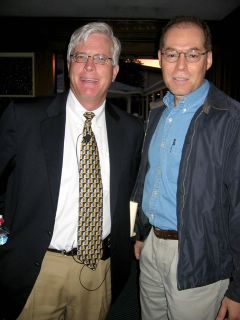
Just returned from a Stand to Reason event at Calvary Church in Santa Ana, California. Hugh Hewitt was the guest speaker, with Greg Koukl closing the evening with a short talk and a status report on Stand to Reason.
In his talk, Hugh emphasized the need for Protestants, Roman Catholics, and Jews to come together as a force to oppose the threat to moral values that our culture now faces (e.g., religious liberty, judicial power-grabbing, the sanctity of human life). He even included Mormons as our allies, noting that while our theological differences are very real, we still share a common enemy (likening the fight to that of allying with the Soviet Union in order to defeat the Nazis).
While he pointed out that Christians do not need to drop their concerns of theological (and creedal) differences, we do need to understand that forming a coalition based on shared values will better enable us to protect religious liberty.
Three core issues he stressed were: 1) God exists, 2) He demands obedience and, 3) He punishes disobedience.
He also gave four, "must-read," book recommendations: 1) That Hideous Strength - C. S. Lewis, 2) The Abolition of Man - C. S. Lewis, 3) Lost in the Cosmos - Walker Percy and, 4) The Thanatos Syndrome - Walker Percy. I've read Lewis' books but have yet to delve into Percy's.
Before the talk I had the chance to speak with Hugh and was mildly chastized for scaling back my posting frequency (see my original post on that topic here and an addendum here). Hugh basically said that, in the medium of blogs, having many short posts outweighs having but a few, extensive posts. Well, I'll see what I can do.
In our short conversation I related the time committment I have towards my family, especially with regards to the home schooling of our two children, and was pleasantly stunned when Hugh mentioned me by name, as a homeschooler, towards the end of his talk. Thanks Hugh!
Greg Koukl rounded off the night by bringing an especially lucid talk on the threat of relativism to the church. He highlighted the dangers the church faces when it embraces such notions as moral relativism as well as post modernism. In particular, he addressed the teachings of the Emergent Church. For a refresher on how I view the dangers inherent in some of the teachings of the Emergent Church, please refer back to my post What is PoMo? and Those PoFolks at PoMo.
It was a very enjoyable evening.
Here I am networking with Hugh Hewitt.

Saturday, April 02, 2005
Pope John Paul II...
 God's servant is called home.
According to my earnest expectation and my hope, that in nothing I shall be ashamed, but that with all boldness, as always, so now also Christ shall be magnified in my body, whether it be by life, or by death. For to me to live is Christ, and to die is gain. But if I live in the flesh, this is the fruit of my labour: yet what I shall choose I wot not. For I am in a strait betwixt two, having a desire to depart, and to be with Christ; which is far better. - Phillipians 1:20-23 (KJV)
More on Modern English...
In my earlier post, on the elegance of Modern English (or lack thereof), I was attempting to highlight the potential absurdity of making a translation (e.g., of the Bible) fit the common vernacular - the lowest common denominator - for the misguided purpose, albeit noble, of making it easier to understand. In doing so I related examples of how I thought that street language - that which happens to be in vogue - has begun to make its way into conversations heard in the "serious" world of business. That such a phenomenon is occurring, I conclude, is merely symptomatic of how we have tended towards "dumbing" ourselves down.
Now this is an inherently complex topic with many distinct aspects, several of which those leaving comments have touched upon. Let me clarify, though, what I was stating by first explaining what I was not stating.
I was not claiming that common vernacular has no place in literature or society in general. I was not claiming that we should all be speaking the King's English. I was not claiming that language does not evolve. I was not claiming that we should necessarily eliminate the use of valid words (e.g., "awesome").
I was claiming, perhaps in too stealthy a manner, that the genre and form of an ancient text should be considered when translating that text into English. In doing so, we must understand that the genre and form of the text were chosen by the author. The author had at least one reason, and quite possibly, many reasons for choosing the genre and form of the text. For example: The form of ancient poetry, very dissimilar to our modern forms, adds significance to the intentions of the author and the meaning of the poem. The choice of specific words used in the original language may have been made to emphasize additional meanings or to drive home an intended point (e.g., by the use of puns). The cadence of the words used may have been used to enhance the ability to memorize the text (especially in cultures where the majority of the populace was illiterate).
The process of translating the text of one language into that of another is a tedious process, to be sure, yet the literary principles mentioned above should be a part of that process. The text, and the author's intentions, should drive how we determine what form our translation takes. The "end user" applications, which we may desire for the text, should not be driving the end product. Was the intent of the author to have the text easy to understand or to be in common, street language? It certainly may have been, as Tom has commented on by leaving excerpts from Catcher in the Rye. But do you see where the extra step has been made if one assumes that a translation, such as that of the Bible, should necessarily be easy to understand and / or published in street vernacular? Doing so, when the text does not justify it, and when the author did not intend it, robs the original of its intended impact.*
Consider the following:
How well God must like you- you don't hang out at Sin Saloon, you don't slink along Dead-End Road, you don't go to Smart-Mouth College. - Psalm 1:1 (The Message)When speaking to children, such a translation would probably be easier for them to understand (note: despite the fact that The Message is a paraphrase, and not a translation, the point of my post remains valid). But The Message was not written for children (necessarily). It is supposed to be for adults. Are we, as a culture, so deeply entrenched in the common vernacular of modern English that we are unable to understand Psalm 1:1 translated as such?:
Blessed is the man that walketh not in the counsel of the ungodly, nor standeth in the way of sinners, nor sitteth in the seat of the scournful. - (KJV)Or, perhaps,
Happy are those who do not follow the advice of the wicked, or take the path that sinners tread, or sit in the seat of scoffers. - (NRSV) Blessed is the man who does not walk in the counsel of the wicked or stand in the way of sinners or sit in the seat of mockers. - (NIV)While one who reads the easier version may think they've understood the meaning, have they not missed the "walk, stand, sit" progression apparent in the more complex versions? Or consider, on a secular level, my paraphrase of an original English text:
Dude, the river is, like, mega-awesome. Y'know what I'm sayin'? When I check out the shore I'm all - like - yeah Dude!, let's give it up for this place. It's so tight.The paraphrase is of a letter written by Meriwether Lewis, in 1804, pertaining to his upcoming voyage with William Clark to explore the territory of the Louisiana Purchase. He wrote (spelling from the original),
This immence river so far as we have yet ascended, waters one of the farest portions of the globe, nor do I believe that there is in the universe a similar extent of country,Doesn't a version in common vernacular due a disservice to the original text? Were I introducing the text to a group of people either incapable of, or unwilling to, understand the more complex version, then perhaps I would be justified in using a simpler, easier to understand, version. However, I believe that such a version is not a valid translation of the original, but merely a simplified paraphrase, which is better suited for either the education of children (or adults), not yet capable of grasping complex issues, or as a commentary on the original text. *As a sidenote, I am well aware of the difficulties involved when one attempts to translate a text, such as the Bible, for various cultures around the world. I understand that such translations must cater to the idiosyncrasies of these various cultures. I'm reminded of hearing one Bible translator, a missionary to the south Pacific, tell how he had to translate "the Lamb of God" as "the Pig of God" in order for it to be understood by a certain culture he encountered. One would hope, though, that if such a culture becomes more educated in the Judeo-Christian tradition, they would come to a point where our expecting them to understand "the Lamb of God" would be justified. However, I do not consider sub-culture groups in the West to be equivalent to various cultures throughout the world. In other words, the Goth, or the Surfers, or the Hip-hop group, or whatever Western cliques we may have are merely groups within the overall Western culture of 21st century America. As such I have somewhat of a deaf ear to concerns that we need to make our Bible translations easier to understand (for such sub-culture groups). Although someone may use the phrase, "I'm so not planning that," they should still have the capability to understand more complex sentences. That such an understanding requires time and effort may be a better indicator of what is truly occurring here.
Sunday, March 27, 2005
On Judicial Kings, Common Law, and Common Sense...
In the obfuscation surrounding the Terri Schiavo case we first need to understand that the point is not how we would want to be treated if we were in Terri's position. That you or I would not want to be continually fed, were we in the same condition, is completely irrelevant.
Consider (from the comments to a previous post),
[u]ltimately this case...is about Theresa Schiavo's right to make her own decision, independent of her parents and independent of her husband....the trial judge [made] a decision that the clear and convincing evidence shows the ward [Mrs. Schiavo] made a decision for herself.Where did this clear and convincing evidence come from, if not from Terri Schiavo? Could it be... Michael Schiavo? If so, then Terri's life hangs in the balance based on Michael's motives and intent. We must understand that the judicial branch of our government does not hold the trump card, so to speak. We are not mandated to bow down to our judicial rulers. While I am certainly not advocating an_rchy, we must become cognizant of the fact that there are legal ways to correct judicial power-grabbing. The Terri Schiavo execution will serve as a wake-up call with regards to a judicial branch run amuck. Lastly, Michael Schiavo's actions, with regards to his current love, are certainly admissible as indicators of motive and intent. While proceedings behind closed courtroom doors may follow the letter of the law, and thus deal a death blow to Terri in the supposed name of dignity, the common man understands quite well what is happening. Consider (also from comments to a previous post),
...an independent report to Gov. Jeb Bush and the judicial system two years ago said 'the evidence is incontrovertible that [Michael Schiavo] gave his heart and soul to her treatment and care.'[XXX]...The exhaustive 2003 report by Jay Wolfson, professor of public health and medicine at the University of South Florida...To keep the proper perspective, at the [XXX], simply insert,
as evidenced by the fact that he now shacks up with his girlfriend and has fathered two children by her.Finally,
...It took Michael a long time to consider the prospect of getting on with his life---something he was actively encouraged to do by the Schindlers...He was even encouraged by the Schindlers to date...Maybe a little clarification is in order here... To impregnate your live-in girlfriend twice is not equivalent to "dating." Again let's try a little common sense - if your spouse were to start dating wouldn't you assume that your marriage was, for all intents and purposes, over? How about if your spouse either impregnated their lover a couple of times (or was impregnated a couple of times)? Who would, in their right mind, not think that such a spouse was anything more than a cheating two-timer? If the judicial branch were truly interested in executing law, they would have declared Michael and Terri divorced, and turned guardianship over to those blood relatives who have continually expressed a desire to love and care for her. While the judicial branch seems confused by Michael's actions, the common man is not.
On Resurrection Day...
From a post published on May 26, 2004:
Back around Resurrection Day (Easter) I received an e-mail from a reader named Darren who inquired about potential discrepancies contained within the four narratives on the Resurrection of Christ. He said, among other things,
If you contrast the accounts of the resurrection in the book of Matthew to that written in the book of John, there are some discrepancies that make the resurrection seem less than plausible. In Matthew we read of a post-resurrection story where the two Marys are greeted at the tomb by an angel who had just rolled away the stone from its entrance. After revealing to both women the empty place where Jesus’ body once laid, the angel proclaims to them that Jesus had already risen from the dead. The angel goes on to instruct both Marys that they are to tell the disciples that Jesus had gone before them to the Galilee to meet them. (Matthew 28:1-7) If that encounter wasn’t convincing enough for the two women, Matthew continues to relate how, after leaving the tomb, both Marys unexpectedly meet the resurrected Jesus himself, whom they both worship. Jesus then essentially repeats the angels instructions to them, and sends the women to inform the disciples that they are to meet the resurrected Jesus in the Galilee. (Matthew 28:8-10) In Johns version of the first Easter morning, when Mary Magdalene comes to the tomb, there is no angel there to greet her with information about Jesus’ whereabouts or instructions about a rendezvous in the Galilee as we find in Matthews account (Matthew 28:5-7). On the contrary, in Johns story, after Mary finds the empty tomb, she concludes that someone had removed the body from the grave. Mary certainly had no reason to believe otherwise. She therefore quickly runs back to the disciples and reports, “They have taken the Lord out of the tomb, and we do not know where they have laid him!” (John 20:1-2) The above account is entirely inconsistent with Matthews post-resurrection narrative. Why didn’t Mary know that Jesus’ body was not laid anywhere? In Matthews story, the angel had already reported to her that Jesus rose from the dead and had gone to the Galilee. It would therefore have been ridiculous for her to think that someone had moved the body when the angels had already informed her that Jesus’ resurrection had occurred. Moreover, if the angels instructions to her were not convincing enough, Matthew maintains that Mary also met the resurrected Jesus himself right after leaving the tomb (Matthew 28:9); and all this transpires before Mary ever sees the disciples. Why then in Johns Gospel is Mary clueless as to where Jesus’ body was moved, when according to Matthew, Mary had already heard from two reliable sources, the angel at the tomb and Jesus himself, that Jesus rose from the dead?Not surprisingly, Darren also had questions about whether the doctrine of the Trinity is truly taught in the Bible. I will not address Trinitarian doctrine on this post but concentrate, instead, on the Resurrection. There are many sources of information with regards to the historicity of the Resurrection accounts, e.g., William Lane Craig, or Jeremy Pierce (from Parablemania), but I found two sources to be particularly helpful with regards to the issue of contradictions within the accounts. One was Alleged Discrepancies of the Bible, by John W. Haley, and the other was Encyclopedia of Bible Difficulties, by Gleason Archer. Archer states, with regards to the four Gospel accounts,
The very fact that each of the four writers contributed individual details from his own perspective and emphasis furnishes the most compelling type of evidence possible for the historicity of Christ’s conquest over death and the grave. A careful examination of these four records in comparison with another demonstrates that they are not in any way contradictory, despite the charges leveled by some critics. It is helpful to synthesize all four accounts in order to arrive at a full picture of what took place on Easter itself and during the weeks that intervened until the ascension of Christ.In our Western cultural mentality we tend to look for detailed and exact accounting with regards to historical presentation. Our typical view of a genealogical listing, for example, is that it be as detailed, precise, and comprehensive as possible. Yet cultures from the past, the Middle East in particular, viewed a genealogy as a means of identifying how ancestor A got to ancestor Z, regardless of whether every intermediate ancestor was listed. Reading a genealogy, written in a different culture, with our 21st century mindset may give us a false impression of the information being conveyed. Similarly, we need to understand that multiple accounts of the same event need not be exactly the same, so long as they are not formally contradictory. That said, it should not be surprising that events listed in one account of the resurrection may or may not be listed in another account. Further, we must be careful not to make the assumption that if an event was not listed in an account, then it means that the event did not occur. An omission of data is simply that – an omission. Also, we should be aware that a writer may skip a portion of the narrative that he felt unnecessary to include. That seems contrary to our mentality which states that if we want to prove a point (e.g., the resurrection), then we should outline all the pertinent facts. Of course this ignores the probable fact that the Gospel writers did not include every detail anyway. Lastly, we need to be cognizant of the fact that we are reading the account with full knowledge of events prior to and after the resurrection. We understand the meaning and purpose of Jesus’ resurrection only because of the chasm that the initial witnesses spanned as it was revealed to them. Archer analyzes the four Gospel accounts as such:
On Saturday evening three of the women decided to go back to the tomb belonging to Joseph of Arimathea, where they had seen Christ’s body laid away on Friday at sundown. …There were three women involved (Mark 16:1)… They apparently started their journey from the house in Jerusalem while it was still dark, even though it was already early morning (John 20:1). But by the time they arrived, dawn was glimmering in the east (Matt. 28:1).Where the women were, when the earthquake occurred in which the angels rolled away the stone from the tomb, we are not told. They were apparently unaware of the event given their reaction upon reaching the tomb and finding the stone rolled away for them. Archer continues,
They then entered the tomb, side-stepping the unconscious soldiers. In the tomb they made out the form of the leading angel, appearing as a young man with blazing white garments (Mark 16:5), who, however, may not have shown himself to them until they first discovered that the corpse was gone (Luke 24:2-3). But then it became apparent that this angel had a companion, for there were two of them in the tomb.The angel tells the women not to be afraid, yet one can hardly expect them to immediately calm down. The angel also reminds them that Christ Himself had spoken of His resurrection and that they are to go and tell His disciples that He had risen from the dead. In the Gospels we see, time and time again, that Jesus’ identity as Messiah is intentionally revealed and not necessarily deduced. That his resurrection could be both knowable and yet unexpected should not surprise us. We are told in John 20:9, “For they did not yet understand the scripture that Jesus must rise from the dead.” It is sometimes difficult for us to realize the paradigm shift in thinking that the disciples had to go through, e.g., even after they understood that Jesus was resurrected, they still expected Him to begin His earthly reign as Messiah (Acts 1:6). Thus, the women leave the tomb, for the first time, and tell the disciples that, “They have taken the Lord away from the tomb, and we don’t know where they have laid Him!” (John 20:2). The Jewish concept of the resurrection was that all were resurrected at the end of the age. That Jesus was to rise from the dead, on his own, was a foreign concept to them, not to mention that at this point in time they had yet to see Jesus for themselves. Regardless, Peter and John decide to inspect the tomb for themselves (John 20:3). Archer states,
John arrived there first, being no doubt younger and faster than Peter. Yet it turned out that he was not as perceptive as Peter, for all John did when he got to the entrance was stoop down and look into the tomb, where he saw the shroud… But Peter was a bit bolder and more curious; he went inside the chamber and found it indeed empty. Then he looked intently at the winding sheet… Instead of being spread out in a long, jumbled strip, it was still wrapped together in one spot…It appears that Mary Magdalene decided to return to the tomb after Peter and John. There is no mention of whether Peter and John saw her at the tomb or on their way back home. After she returned to the tomb she was once again greeted by the angels who asked her why she was crying. She apparently still had not understood the full meaning of what the angels had initially told her. After asking the angels, “They have taken my Lord away, and I do not know where they put him,” Jesus appears behind her. She turns to see him but does not recognize him. We are not told whether this was intentional on Jesus’ part or whether it was due to Mary’s emotional state. Per Archer,
It was at this point that the kindly stranger revealed Himself to Mary by reverting to His familiar voice as He addressed her by name, “Mariam!” Immediately she realized that the body she was looking for stood right before her, no longer a corpse but now a living, breathing human being – and yet more than that, the incarnate God. “Rabbouni!” she exclaimed (that is to say, “Master!”) and cast herself at His feet.Jesus then instructs her to return and tell His disciples that He must briefly ascend to the Father (John 20:17). Conferring with Matthew 28:9 we see that the other women also returned to the tomb and were met by Jesus as well, although we are not told if they met Jesus specifically at the tomb. That point is important because Peter appears to be the first male disciple to be visited by Jesus after His resurrection for when the women returned the second time from the tomb to report their news of meeting Jesus, the disciples replied, “The Lord has really risen, and has appeared to Simon!” (Luke 24:34). We are told that Jesus had appeared to Peter, but we are not told when or where the event happened. This is just a brief analysis of the Gospel accounts regarding the resurrection. Far from being contradictory in nature, the Gospels provide a rich tapestry of detail with regards to the various events surrounding that unique day two thousand years ago.
Friday, March 25, 2005
On Good Friday...
 They came to a place called Golgotha (which means "Place of the Skull") and offered Jesus wine mixed with gall to drink. But after tasting it, he would not drink it. When they had crucified him, they divided his clothes by throwing dice. Then they sat down and kept guard over him there. Above his head they put the charge against him, which read: "This is Jesus, the king of the Jews." Then two outlaws were crucified with him, one on his right and one on his left. Those who passed by defamed him, shaking their heads and saying, "You who can destroy the temple and rebuild it in three days, save yourself! If you are God’s Son, come down from the cross!" In the same way even the chief priests—together with the experts in the law and elders—were mocking him: "He saved others, but he cannot save himself! He is the king of Israel! If he comes down now from the cross, we will believe in him! He trusts in God—let God, if he wants to, deliver him now because he said, 'I am God’s Son'!" The robbers who were crucified with him also spoke abusively to him.
Now from noon until three, darkness came over all the land. At about three o’clock Jesus shouted with a loud voice, "Eli, Eli, lema sabachthani?" that is, "My God, my God, why have you forsaken me?" When some of the bystanders heard it, they said, "This man is calling for Elijah." Immediately one of them ran and got a sponge, filled it with sour wine, put it on a stick, and gave it to him to drink. But the rest said, "Leave him alone! Let’s see if Elijah will come to save him." Then Jesus cried out again with a loud voice and gave up his spirit. Just then the temple curtain was torn in two, from top to bottom. The earth shook and the rocks were split apart. And tombs were opened, and the bodies of many saints who had died were raised. (They came out of the tombs after his resurrection and went into the holy city and appeared to many people.) Now when the centurion and those with him who were guarding Jesus saw the earthquake and what took place, they were extremely terrified and said, "Truly this one was God’s Son!" - Matthew 27:33 - 54 (NET)
They came to a place called Golgotha (which means "Place of the Skull") and offered Jesus wine mixed with gall to drink. But after tasting it, he would not drink it. When they had crucified him, they divided his clothes by throwing dice. Then they sat down and kept guard over him there. Above his head they put the charge against him, which read: "This is Jesus, the king of the Jews." Then two outlaws were crucified with him, one on his right and one on his left. Those who passed by defamed him, shaking their heads and saying, "You who can destroy the temple and rebuild it in three days, save yourself! If you are God’s Son, come down from the cross!" In the same way even the chief priests—together with the experts in the law and elders—were mocking him: "He saved others, but he cannot save himself! He is the king of Israel! If he comes down now from the cross, we will believe in him! He trusts in God—let God, if he wants to, deliver him now because he said, 'I am God’s Son'!" The robbers who were crucified with him also spoke abusively to him.
Now from noon until three, darkness came over all the land. At about three o’clock Jesus shouted with a loud voice, "Eli, Eli, lema sabachthani?" that is, "My God, my God, why have you forsaken me?" When some of the bystanders heard it, they said, "This man is calling for Elijah." Immediately one of them ran and got a sponge, filled it with sour wine, put it on a stick, and gave it to him to drink. But the rest said, "Leave him alone! Let’s see if Elijah will come to save him." Then Jesus cried out again with a loud voice and gave up his spirit. Just then the temple curtain was torn in two, from top to bottom. The earth shook and the rocks were split apart. And tombs were opened, and the bodies of many saints who had died were raised. (They came out of the tombs after his resurrection and went into the holy city and appeared to many people.) Now when the centurion and those with him who were guarding Jesus saw the earthquake and what took place, they were extremely terrified and said, "Truly this one was God’s Son!" - Matthew 27:33 - 54 (NET)
Thursday, March 24, 2005
How undignified!...
CNN has the answer to why it is okay for judges to order the execution of Terri Schiavo. From it's main web page (as of 9:20 p.m. PST), we read:
Hours after the U.S. Supreme Court rejected pleas to intervene in the case of Terri Schiavo on Thursday, her parents again asked a federal judge in Florida to order the brain-damaged woman's feeding tube restored. Courts have consistently ruled against her parents, who want to keep her alive, and in favor of her husband, who says he wants her to die with dignity. (emphasis added)Of course. That's it. While her cheating husband wants her to die with dignity, her loving parents want her to remain undignified (i.e., alive). God help us.
On Terri...
From a post I wrote in October of 2003:
...This is scary folks. All arguments regarding the courts and judges and lawyers aside, there are some incredibly crazy thoughts here.
Jeb Bush has ordered that nutrition and water be given to Terri, overruling a court order which removed them from her about 5 days ago. Do you understand what is going on here? A U.S. Court ordered that Terri Schiavo be starved to death!
According to the article [per outdated Reuters' link],
"Republican state Sen. Tom Lee said senators felt political pressure to quickly approve the bill or be blamed "for killing Terri Schiavo." "Some people came up with a political brainstorm to use this woman's life as a political football, to appeal to the Christian conservatives in this state who will never understand the details that construct this case," Lee said. Some lawmakers and scholars questioned whether the state constitution authorized the legislature to give the governor power to overrule a court."That's right Tom, blame it on those moronic Christian conservatives who will never understand anything as complicated as this court case. From Boykin to Ashcroft to Schiavo supporters... it's those radical right Christians. Tell me Tom, do you have the fortitude to watch Terri starve to death? Do you understand that it is a long, painful process? Will you monitor her condition as her life slowly slips away? Note the ending of the article,
"Robert Schindler [Terri's father] was delighted with Tuesday's turn of events, telling reporters outside the hospice where Schiavo is being treated in Pinellas Park, a suburb of St. Petersburg, "It's incredible." But George Felos, an attorney for Schiavo's husband, called the legislature's action unconstitutional and said he would try to have the bill overturned. Felos also said he would file civil suits against anyone who helped put Schiavo back on life support."Life support? This is completely false. Terri is not on life support... she is being provided with nutrition. Maybe attorney George Felos should be reminded of that the next time he sits down for a meal? What should be scary here is the lack of outrage we see on the streets. Is this indicative of agreement by a majority of Americans with the court's decision to starve Terri to death? If so... where will it stop? Update: I was stunned on the commute home from work today. I carpool, and it was my turn to drive. I had Hugh Hewitt on and, of course, he was discussing the slow execution that Terri Schiavo is now experiencing. My carpool partner, upon hearing Hewitt's doubts regarding Michael Schiavo's veracity as Terri's husband, since he lives with his girlfriend and has fathered two of her children, turned to me and said, "I didn't know that!" It's truly mindboggling that entire segments of our population haven't a clue about what is going on here. Then again... maybe it isn't.
Saturday, March 19, 2005
The elegance of modern English...
I was walking down a hallway at work one day and crossed paths with two women. As they passed by, I overhead one of them say to the other, "We are so not planning that this year!"
We are so not planning that? I thought. Was that equivalent to stating, "We are definitely not planning that"? Mind you, they were not a couple of 14 year old adolescents but were, supposedly, working professionals.
Recently I read a mailer from a Christian organization which attempts to reach out to today's youth - the so called Emerging Generation. One of the youth mentors was interviewed in the piece and, despite the interview being only a few paragraphs long, used the word awesome at least four times.
Are our 21st century minds truly that limited?
I've had colleagues, in their 30's no less, tell me that they "googled" something on the internet. I thought Google was a noun, not a verb. This was, of course, after they addressed me as "dude." These same individuals will respond on an instant message with "k" instead of "OK." I suppose it's important to save that one keystroke (and the "shift" key... to avoid the extra time to enter UPPERCASE letters).
Are we really in that much of a hurry? Is there any elegance left in our communication when we resort to using the language of simpletons?
In Lelan Ryken's book, The Word of God in English, he refers to the elegance of a translation as applied to beauty and to cadence. While a simpler version may be more readily understandable, he argues that the more complex version is more lasting, and more easily remembered. Consider the following passage from Phillipians, in the King James Version:
Finally, brethren, whatsoever things are true, whatsoever things are honest, whatsoever things are just, whatsoever things are pure, whatsoever things are lovely, whatsoever things are of good report; if there be any virtue, and if there be any praise, think on these things. - Phillipians 4:8Now compare it with the simpler, and more easily understood paraphrase found in The Message:
Summing it all up, friends, I'd say you'll do best by filling your minds and meditating on things true, noble, reputable, authentic, compelling, gracious - the best, not the worst; the beautiful, not the ugly; things to praise, not things to curse.While one version is certainly easier to understand, is the more complex version beyond our grasp? p.s. dude, i googled on elegance but way too many hits came up. i was all, like... i am so not going to search through that. dude, it would be so not awesome. y'know what i'm saying? k. Update: I think it's awesome that this post generated so many comments. I was just telling my wife about what an awesome opportunity we have to blog about blogging on our blogs. To see the influence such power can wield is truly an awesome experience. I'm hoping for some more exciting and awesome adventures in the road ahead. (note: I really don't have anything against the word awesome... I simply wish that some people would attempt to spice up their vocabulary with a bit more variety)
Friday, March 18, 2005
Friday Rant, 3/18/05...
The execution of Terri Schiavo has begun, in a most cruel and unusual manner. Schiavo's husband is supposedly at her bedside, evidently taking time away from his girlfriend and her children, whom he fathered. An attorney, in league with the executioners, stated that Terri has a right to die in peace. A bullet to the back of the head would be a more peaceful way to leave this earth...
John Evander Couey has reportedly confessed to kidn_pping and k_lling 9 year old Jessica Lunsford. John Evander Couey is a convicted s_x offender who was residing, not where he had reported to authorities, but across the street from where Jessica lived. How does law enforcement lose track of the whereabouts of a convicted s_x offender? Shouldn't we be the least bit concerned? Why are we not serious about protecting our children?
Why do we care about Brian Nichols and whether his choice of h_stage, Ashley Smith, was part of God's Will? The man brutally m_rdered four people. He chose his actions. While I wouldn't wish the ordeal Smith went through on anyone, her compassion might be better directed towards the families of those four innocent victims. Nichols may indeed spread the word of God to fellow prisoners, but his earthly actions deserve earthly payment. If God could bring Nichols to Smith's door, then why couldn't God have brought him to the courtroom, sans four corpses? And does anyone else see a bit of aberrant theology driven, perhaps, from expecting a purpose in the whole episode?
Education Taxed By Non-English Speaking Kids.
One in six students in California are children of illegal immigrants though many are born in the United States and therefore are U.S. citizens.I like to be in America, Okay by me in America. Everything free in America, For a small fee in America. Per FoxNews,
A 5-year-old girl was arrested, cuffed and put in back of a police cruiser after an outburst at school where she threw books and boxes, kicked a teacher in the shins, smashed a candy dish, hit an assistant principal in the stomach and drew on the walls.The girl's mother said, She's never going back to that school. They set my baby up. Yeah, that's it.
Tuesday, March 15, 2005
Science & Christianity...
Caetz, over at Allthings2All, has the Science & Christianity Showcase up. Stop by and read some very good posts that she has assembled from various Christian bloggers.
Saturday, March 12, 2005
A Phased Schedule: how to summarize an entire project (such as creation)...
In dealing with the debate between the young earth and old earth creation scenarios we must always remember to not limit our analysis to just the text of Genesis 1. The Bible has various other references to God's activity in creation (Genesis 2, Job 38, and Psalm 104 immediately come to mind) and if we are to fully understand this activity then we must strive to harmonize the various passages.
A question (or some variation thereof) that young earth proponents frequently ask is, why should we take the days to be long periods of time when the text clearly states that they were days? While there are hermeneutical reasons why the old earth stance is permissible, I would rather address the possible reasons why, when we read the text of Genesis 1, we may come away thinking that the creation days must be six 24 hour periods.
The first reason, of course, is that the text lays out the creation events into six periods, using terminology that could lead one to believe that the periods correspond directly with our days of the week. Yet note what just transpired - we see a direct correspondence between God's action during creation and the days of our week. Was the intent, or one of the intents, of the creation account to give us information as to the age of the universe and / or the length of time God used in creating? Or was the intent, or one of the intents, of the creation account to illustrate a pattern that virtually all peoples could relate to and understand? (namely, that of the 6 / 1 pattern) Even a cursory review of the scriptures will reveal virtually nothing written to reveal the age of the universe / earth in terms of actual numbers, yet we see an immensely rich use of the 6 / 1 pattern.
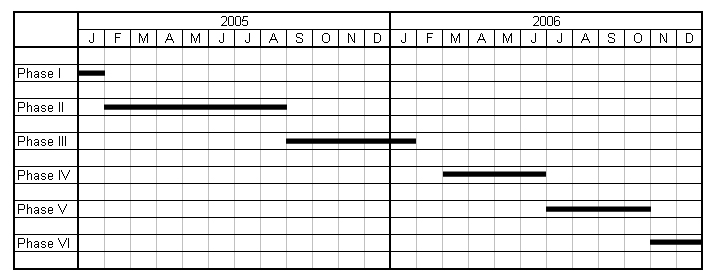
As a planner/scheduler I can appreciate the use of a summarized schedule which one can use to represent an entire project of virtually any duration. Consider the graphic below.

This is a simple summarized schedule, representing a project that spans the duration of two years. Typically a project that involves engineering, purchasing, manufacturing, and construction will be broken down into various groups, or phases. The actual distinction between phases is subjective and can be assigned on a per project basis. For one project it might make sense to base the phases directly on the engineering, purchasing, manufacturing, and construction sequences. For another project it might make more sense to base the phases on physical areas of work at the project site. The point to understand is that any project can be categorized into groups of work (or phases). Note how, in the graphic above, I have listed 6 phases of work which span across the two year time period. The 6 phases of work, while they encompass the entire project duration, are not equal in duration themselves. Phase I is only 1 month long and Phase II is 7 months long. However, note that the phases follow each other in sequence (this is not a necessity, but is used here for the illustration). When schedules such as these are presented to management, or to the client, the duration and timing of the project and of each phase is extremely important. The reason for this is typically because it is our intent to demonstrate how quickly the project will be completed. After all, time is money. Yet, what if my intentions were to present the schedule of this project to a group of people, not to inform them of the duration of the project, but to definitively state for them who was in charge of the project and to set up the foundation for the six phase pattern I would later use in guiding them? I'd probably give them something like that of Genesis 1.
This is a simple summarized schedule, representing a project that spans the duration of two years. Typically a project that involves engineering, purchasing, manufacturing, and construction will be broken down into various groups, or phases. The actual distinction between phases is subjective and can be assigned on a per project basis. For one project it might make sense to base the phases directly on the engineering, purchasing, manufacturing, and construction sequences. For another project it might make more sense to base the phases on physical areas of work at the project site. The point to understand is that any project can be categorized into groups of work (or phases). Note how, in the graphic above, I have listed 6 phases of work which span across the two year time period. The 6 phases of work, while they encompass the entire project duration, are not equal in duration themselves. Phase I is only 1 month long and Phase II is 7 months long. However, note that the phases follow each other in sequence (this is not a necessity, but is used here for the illustration). When schedules such as these are presented to management, or to the client, the duration and timing of the project and of each phase is extremely important. The reason for this is typically because it is our intent to demonstrate how quickly the project will be completed. After all, time is money. Yet, what if my intentions were to present the schedule of this project to a group of people, not to inform them of the duration of the project, but to definitively state for them who was in charge of the project and to set up the foundation for the six phase pattern I would later use in guiding them? I'd probably give them something like that of Genesis 1.
Sunday, March 06, 2005
Reading naturally...
Dory, over at Wittenberg Gate, is in the middle of a series of posts dealing with Death before the Fall. As part of her argument, she addresses the various interpretations of the Genesis 1 creation account with regards, mainly, to whether or not the text indicates 6 24 hour days or 6 long periods of time. She refers to the concept of "natural reading" and states,
First, I would like to make the point that if someone was confronted with the text of the first two chapters of Genesis and had no preconceived notions about it, he or she would come away with the idea that this text asserts that in the space of six days God created time, matter, and space, organized those elements to form the earth, moon, stars, etc., and made the earth's plants and its animal and human life. This is what I will refer to as a natural reading of the text. This is different than a literal reading of the text. If I said it was raining cats and dogs, a literal understanding of that would be absurd. However a natural reading of that statement is to recognize an obvious metaphor, or use of poetic speech, and understand that it is raining heavily. I do not believe that Scripture should always be read literally, however, I would assert that it needs to be read naturally. Determining what is a natural reading of a text can be complicated by cultural differences and translations. This is a common problem with Westerners reading the visionary, and to a lesser extent, the poetic portions of Scripture, as we are not as well exposed to these Eastern literary forms. (We need to improve our education on that, I believe.) Westerners reading the Psalms, for example, generally fail to see the intricate internal structure of these poems unless they are first trained to do so. However, the first chapter of Genesis is not in a poetic or visionary form. The creation is set out as a straightforward history with a chronological structure. There is the beginning, first day, second day, third day, and so on, and then a declaration that the work is complete, followed by rest. To insert a gap into a text that is so focused on a time sequence, seems to be straining the text quite a bit. Anyone asserting that this is necessary ought to bear the burden of proof and show why such a reading is warranted. What could justify a day-by-day rendering of creation events leaving out millions of years?While I agree with Dory that a natural reading of the text, in the proper context, is essential for understanding the text, I would argue that, within the context of the 21st century West, a natural reading of Genesis 1 and 2 could lead to exegetical error. The reason for this is that our "natural reading" of the text is bounded within a 21st century mindset. The very notion of asking "how long did Creation take?" betrays our tainted viewpoint. The ancients would not have asked that question because that was not the point of the text. In other words, although the text describes successive time periods for the Creation, the point of the narrative was altogether different. Consider the narrative describing the Ten Plagues that God brought upon Egypt through Moses. I've written before that the point of the account was to demonstrate God's supremacy over specific deities within Egypt's animistic religious system. The Nile was worshipped; Heqet was a goddess of childbirth and depicted as a frog; Ra was the Sun god. These, and other deities, were systematically defiled by God - who was demonstrating to the Egyptians and to the Israelites that He was sovreign over His creation. A 21st century reader needs to have the specifics of that narrative explained to them - but an Israelite (or an Egyptian) of the period would have clearly understood what was happening. In this case, our natural reading of the text deprives us of the deeper truths intended there for us. In virtually every discussion I've had with a young-earth proponent, the major hurdle I see them approach is the apparent fact that the "plain reading" of the text tells them that the Creation occurred over the space of 6 24 hour days. Perhaps a bit more attention should be given not towards a plain or natural reading, but for the most in depth reading of the text?
Saturday, March 05, 2005
Changes to New Covenant...
On October 17, 2004, I wrote a post explaining how I thought that the time commitment required to maintain a successful blog was excessive - excessive to the point of being unrealistic for a person with the responsibility of a separate job, a spouse, and a family. Since that time I have adjusted the way I write posts, including both their frequency and length.
Due to recent changes in my employment situation I must now implement additional changes to how New Covenant is managed. I am now working a shift in which I must arise at 4:30 a.m., leave for work by 5:30 a.m., and typically return home by 6:00 p.m. While such a schedule allows me to have more time on the weekends I find that my weekdays are filled with other, more pressing, responsibilities.
Thus, I will still attempt to post, although such postings will most likely occur only on weekends. Also, with but a few exceptions, I will no longer respond to comments left on my posts. While I enjoy responding, I have found that such responses almost take as much time to structure as the posts themselves.
I apologize for leaving any ongoing debates mid-stream, but such is the situation at hand.
I will continue to post photos at Imago Articulus as it requires much less of an expenditure of time to accomplish (and it's a real kick!).
Subscribe to:
Posts (Atom)
