Wednesday, June 22, 2005

And yet another Home School energizer...

Again from Instapundit we're linked to Give This 'Attic' A Story To Tell, by Anne Applebaum, and We Are Our History - Don't Forget It, by David Gelernter. Applebaum laments on how the Smithsonian Musuem of American History has become a pop culture stop vs. an education stop for American History. She writes,
When the museum was built in 1964, this sort of thing probably wasn't necessary. But judging from a group of teenagers whom I recently heard lapse into silence when asked if they could identify Lewis and Clark, I suspect it's now very necessary indeed. Opinion polls bear out my suspicions. According to one poll, more U.S. teenagers can name the Three Stooges than the three branches of government. Even fewer can state the first three words of the Constitution. A San Francisco reporter once did an informal survey of teenagers watching Fourth of July fireworks in a park and found that only half could name the country from which the United States had won its independence. ("Japan or something, China," said one seventh-grader. "Somewhere out there on the other side of the world.") We're not talking about ignorance of semi-obscure facts here: We're talking about ignorance of basic information.
Gelernter writes,
To forget your own history is (literally) to forget your identity. By teaching ideology instead of facts, our schools are erasing the nation's collective memory. As a result, some "expert" can go on TV and announce (20 minutes into the fighting) that Afghanistan, Iraq or wherever "is the new Vietnam" — and young people can't tell he is talking drivel.
Indeed. While Home Schooling is not the only avenue in which parents can rightfully inform their children about American History, it certainly provides a wonderful opportunity to steer young minds away from apathetic ignorance and towards responsible knowledge.

Bear it away...

A bit late, but the CNN headline, Former Klansman found guilty of manslaughter, reminded me of this Kate Campbell song.
Bear It Away Four little girls dressed up nice Singing about Jesus, red and yellow, black and white Dreaming of freedom across the land And all God’s children walking hand in hand One deadly blast shattered the peace Making for a dark Sunday morning on Sixteenth Street Who can explain such ignorant hate When the violent bear it away Bear it away, bear it away Merciful Jesus, lift up our sorrow Upon your shoulder and bear it away It hurts my heart to think of them Four little girls and what they could have been But we never know about these things When the violent bear it away

Another Home School Energizer...

From Instapundit, a link to Shooting Down the Breakfast Club, in which the author argues that the reason kids who eat breakfast do better in school is because they're "morning people" by nature. If the kids who skip breakfast, presumably because they're "night owls," would be given the opportunity to sleep longer, then they'd do well in school also. From the article,
Parents often think that children need less sleep as they grow up. The research, on the other hand, shows that adolescents still require a solid nine and a quarter hours of sleep a night—at least as much as their younger counterparts.
It doesn't mention whether or not laziness is also a factor. I've always been suspicious of that all too easy excuse, "Well I'm just not a morning person!". Regardless, Suzanne Venker, in her book, 7 Myths of Working Mothers, also writes about the very real sleep needs of children - needs that are often circumvented through the requirement to arrive at institutionalized daycare by 6 or 7 a.m. One of the beauties of home schooling is that, while you should definitely have a school schedule, you have the freedom to adjust that schedule depending on the particular needs of your children. If they stayed up late the night before, as often happens after mid-week activities at church, then school starts a bit later the next morning.

Sunday, June 19, 2005

Gitmo <> Gulag...

Check On a serious note, Guantanamo is No Gulag, by Professor Bainbridge. Also, Michelle Malkin serves up a short history lesson with links to examples of atrocities committed by regimes such as the Nazis. Finally, Ilona has an interesting perspective in, Democrats are the Epitome of Evil. I completely disagree with her... but it's an interesting perspective nonetheless.

Daycare Redux...

In The Trouble with Day Care -- A Surprising Source, by Al Mohler, we read,
Concern about day care now comes from a rather unexpected source. The May-June 2005 issue of Psychology Today features an article entitled, "The Trouble With Day Care,"...
"The raging debates around maternal guilt, work/family balance, money and childrearing often drown out scientific insights into the developmental impactof day care," Lang warns. "But the latest findings, from a huge, long-term government study, are worrisome. They show that kids who spend long hours in day care have behavior problems that persist well into elementary school."
Even more troubling, from the Psychology Today article,
Consider this: "Developmental psychologists are sweeping this information under the rug, hoping studies will churn out better data soon, argues Jay Belsky, a child development researcher at London's Birbeck College and a longtime critic of his fellow scientists. He contends that the field of developmental psychology is monopolized by women with a 'liberal progressive feminist' bias. 'Their concern is to not make mothers feel bad,' he says."
Also reference my post, Mothers and careers, as well as Suzanne Venker's book, 7 Myths of Working Mothers.

Thursday, June 16, 2005

Rusty Nails, 6/16/05...

Whale Evolution: Looks are everything Instapundit links to the latest Tangled Bank offerings promoting evolutionary scenarios, and our old friend DarkSyde is included in a post on the so-called evolution of whales. Despite the fact that whales are notoriously prone to going extinct, evolutionists continue to cling on to whale fossils, which span across millions of years, as being the long lost transitional fossils so readily absent from the fossil record. The basis for such a claim rests mainly on how whale fossils apparently look like they transition from one form to another. Despite admissions that the proposed evolutionary lineages are sketchy at best, despite the fact that the proposed time of transition is woefully short to encompass the necessary changes, and despite the lack of any clear despcription of a mechanism that could produce such changes*, we still see blatant examples of Berra's Blunder. The bottom-line is that the examples presented as transitional fossils are nothing more than intermediate forms. Evolutionary "lensing," that is, viewing the data through strictly evolutionary spectacles, results in strictly evolutionary explanations. The notion that, transitional in nature is not the same as intermediate in form, never seems to occur to the evolutionist. For a classic look at how major changes* in proposed whale evolution are glossed over, view the QT video from the PBS series Evolution (especially note the animation towards the end of the clip).
####
The Left is Lost Per FoxNews, regarding an FBI report on the treatment of prisoners at Guantanamo Bay, Cuba, Senator Dick said,
If I read this to you and did not tell you that it was an FBI agent describing what Americans had done to prisoners in their control, you would most certainly believe this must have been done by Nazis, Soviets in their gulags or some mad regime — Pol Pot or others — that had no concern for human beings
Utterly Disgraceful Let him know at dick@durbin.senate.gov
####
A New Blog lurking in the shadows Longtime commenter Bonnie, from Off the Top, will be teaming up with Marla Swoffer (who probably owns a few Swiffers), on a new seven-woman blog to be titled Intellectuelle. A seven-woman blog? Sigh. Should I get the ACLUnatics to sue for gender discrimination?
####
You won't see this on the boob tube Per Michell Malkin
Comedienne Rosie O'Donnell banned her partner Kelli Carpenter from breastfeeding their daughter Vivienne just a few weeks after she was born--because she was jealous of their bonding sessions. Kelli gave birth to Vivienne in 2002, and the lesbian couple have been raising her along with their three other adopted children. But O'Donnell admits she felt left out of the motherhood process whenever she observed her partner nursing their child.
Sounds like Rosie needs just a bit more Left Leaning Tolerance.
####
* There are a variety of changes that must take place for a wolf-like land based mammal to transition first into a fresh-water and then salt-water based whale. In Michael Denton's book, Evolution: a Theory in Crisis, we find that the wolf-like mammal must,
cease using its hind legs for locomotion and to keep them permanently stretched out backwards on either side of the tail and to drag itself about by using its fore-legs. During its excursions in the water, it must have retained the hind legs in their rigid position and swim by moving them and the tail from side to side. As a result of this act of self denial we must assume that the hind legs eventually became pinned to the tail by the growth of membrane. Thus the hind part of the body would have become like that of a seal. Having reached this stage, the creature, in anticipation of a time when it will give birth to its young under water, gradually develop apparatus by means of which the milk is forced into the mouth of the young one, and meanwhile a cap has to be formed round the nipple into which the snout of the young one fits tightly, the epiglottis and laryngeal cartilage become prolonged downwards so as tightly to embrace this tube, in order that the adult will be able to breath while taking water into the mouth and the young while taking in milk. Be it noted that there is no stage intermediate between being born and suckled under water and being born and suckled in the air. At the same time various other anatomical changes have to take place, the most important of which is the complete transformation of the tail region. The hind part of the body must have begun to twist on the fore part, and this twisting must have continued until the sideways movement of the tail developed into an up-and-down movement. While this twisting went on the hind limbs and pelvis must have diminished in size, until the latter ceased to exist as external limbs at all, and completely disappeared in most, whales.
But none of this is a problem as long as you keep repeating to yourself that the fossils look so similar that the only possible explanation is that they must have transitioned into the forms we see through tiny changes over long periods of time.

Wednesday, June 15, 2005

Homeschool energizers...

Every so often my wife and I get a reminder of why we home school our children. Recently, after a dinner at my parent's house, we sat around the dining table and chatted. I commented on how the same amount of time has passed, since 9/11, as between the attack on Pearl Harbor and the end of WWII. My mother then recalled how, at the end of WWII, her elementary school teacher, the wife of a Baptist preacher, led their class in a prayer. She paused for a moment, and then reiterated, "and this was in school!" Our four year-old looked up and proudly said,
We do that every day in school!
Yeah, that's it. For an idea of what so-called freethinkers think about the issue of prayer in school (or prayer in general), check out Infidels.com, EvolveFish.com, or Americans United for Separation of Church and State.
####
At our Home School Open House this week we were treated to a short-sermon by a ninth-grader in our group. It was refreshing to see that he has grasped the basic fundamentals in Biblical understanding what with his comments regarding a certain verse in the Bible. Which verse? You guessed it - Jeremiah 29:11, "For I know what I have planned for you," says the Lord. "I have plans to prosper you, not to harm you. I have plans to give you a future filled with hope." Questioning why this verse seems to be quoted so much by Christians, he wondered why Christians didn't quote other verses of the Bible so vigorously - verses such as Matthew 5:30, "If your right hand causes you to sin, cut it off and throw it away! It is better to lose one of your members than to have your whole body go into hell." If one is to read the Bible, then one should read the entire Bible, and not simply the passages that happen to make one feel good. How wonderful to see that a ninth grader has a better understanding of Biblical interpretation than many adults!

Another Heard song...

All Is Not Lost - by Mark Heard When civilization takes a nasty turn And concepts are hushed when books are burned All is not lost All is not lost When swine are the ones who steal the pearls From the human oysters of the western world All is not lost All is not lost TRUTH LIVES ON TRUTH LIVES ON TRUTH LIVES ON When beauty seems beaten by the callous beasts And it looks like it will be 'cause history repeats All is not lost All is not lost You can still see grace in the children's eyes And this planet's face still gladdens the wise All is not lost All is not lost TRUTH LIVES ON TRUTH LIVES ON TRUTH LIVES ON When the hand of man becomes inept And sketches the truth in silhouette All is not lost All is not lost The hand of God has not worked in vain And this globe is fodder for the feeblest brain All is not lost All is not lost TRUTH LIVES ON TRUTH LIVES ON TRUTH LIVES ON

Sunday, June 12, 2005

Stay Tuned...

Well I'm back. It was a hectic week away from home, and tomorrow night (Monday) we have an Open House with our Home School ISP. Thanks for the kind words in the comment section (and for confirming that I've got at least 7 readers). I've got a lot of things I'd like to write about... but I've still only been able to squeeze 24 hours out of a day. In the meantime, to stir up your thinking juices, here are the lyrics from a song by the late great Mark Heard.
The Golden Age They say this is the Golden Age Video millennium Tidings from the self-made media sage Tickings of the bio-bomb Jet-set etiquette consciousness Monosyllabic goodbyes No one cares about no one else We're so used to the capital "I" THE GOLDEN AGE (Electric Neanderthal) THE GOLDEN AGE (With digital morality) THE GOLDEN AGE NOTHING REALLY CHANGES IN THE GOLDEN AGE They say this is the Golden Age In which both virtue and flaw And the entire human element Are effects of the quantum laws Deep in the wells of the centrifuge The spectrum of the soul is mined It seems we know ourselves too well And we don't like what we find THE GOLDEN AGE (Electric Neanderthal) THE GOLDEN AGE (With digital morality) THE GOLDEN AGE NOTHING REALLY CHANGES IN THE GOLDEN AGE They say this is the Golden Age We've got the tapes of the truth in drag We've got thermographs of the fires of hell And renderings of the cosmic bang If this is the Golden Age Are we no longer human beings Are we civilization's afterbirth Some kind of flesh and blood machines THE GOLDEN AGE (Electric Neanderthal) THE GOLDEN AGE (With digital morality) THE GOLDEN AGE NOTHING REALLY CHANGES IN THE GOLDEN AGE

Thursday, June 02, 2005

Out of town...

For my 5 readers... I'll be out of town until Friday, June 10th. Happy blogging!

Tuesday, May 31, 2005

See no evil...

Sometimes we only see what we want to see. In a recent post, Instapundit claims that
there's not much support for the idea that more-available porn (or pro-sex material generally) is doing any harm to America's children.
Only a few posts earlier, though, he praises a new children's book by Buzz Aldrin because, as per the NY Times,
Thanks to video games, TV shows and movies such as ''Star Wars: Episode III -- Revenge of the Sith'' that are loaded with special effects, today's children don't have a realistic impression of space or space travel...
Thus, on the one hand, more-available porn is not adversely affecting America's children; but on the other hand, more-available sci-fi is. How about a re-write? Consider,
there's not much support for the idea that video games, TV shows and movies such as "Star Wars: Episode III --- Revenge of the Sith" are giving today's children an unrealistic impression of space or space travel...
and
Thanks to more-available porn, today's children don't have a realistic impression of sex.
Yeah, that's it.

Monday, May 30, 2005

To Serve Man...

"Why should I follow Christ?" Is the 21st century paraphrase of this question, What's in it for me? Contrast with the first century question, "What must I do to be saved?" (Acts 16:30) I recently heard preaching which included the line, "Jesus looked beyond my faults and saw my needs." Jesus looks beyond my faults? Is this the same Jesus that initially said, after a paralytic was lowered to him through a hole cut in the roof above, "Son, your sins are forgiven" (Mark 2:5)? Or is it the same Jesus who told the sinful woman that anointed him, "Your sins are forgiven" (Luke 7:48)? Perhaps it was the Jesus who told the woman caught in adultery, "Go, and from now on do not sin any more" (John 8:11)? My concern with over-emphasizing the relational and "need-meeting" aspect of encountering Jesus Christ is that we tend towards glossing over the politically incorrect notion that we are sinners in need of redemption. Jesus does not look beyond our faults. He stares right at them and brings them to our attention. Indeed, if it weren't for our faults, there would have been no need for redemption. That He is able to meet our needs is but the downstream result of whether or not we acknowledge our need for redemption.

Monday, May 23, 2005

Jesus, I am so in love with You

There are several good posts at Mere Comments regarding the phenomenon of how we tend to so focus our worship towards Jesus, that we effectively ignore the first and third persons of the Trinity. S. M. Hutchens writes, The Problem with Loving Jesus and More on Loving Jesus, and Russell Moore writes, Where Everybody is Somebody, and Jesus Ignored. What is it about our culture, here in America, that motivates us to emphasize a personal relationship with this Jesus who loves us? Do we tend to overemphasize this aspect and, as a result, the person of Jesus in our worship? Consider the worship song Let My Words Be Few, from which partial lyrics were used as the title for this post.
You are God in heaven And here am I on earth So I'll let my words be few Jesus, I am so in love with You The simplest of all love songs I want to bring to You So I'll let my words be few Jesus, I am so in love with You
Is this a pattern that is modeled in scripture? What are we to make of, say, Psalm 100?
Make a joyful noise to the Lord, all the earth! Serve the Lord with gladness! Come into his presence with singing! Know that the Lord, he is God! It is he who made us, and we are his; we are his people, and the sheep of his pasture. Enter his gates with thanksgiving, and his courts with praise! Give thanks to him; bless his name! For the Lord is good; his steadfast love endures forever, and his faithfulness to all generations. - (ESV)
Or how about The Lord's Prayer? Or the doxology? Do we, in our eagerness to experience the closeness that a personal relationship entails, lose sight of proper Biblical Theology in the process? Why, indeed, do we worship God? Stop and listen to the lyrics of most of the worship songs sung at a typical evangelical church. Do the songs primarily echo the fact that God is God, and He is owed worship simply because of who He is (remember the Greatest Commandment)? Or do they more often than not exude experiential fluff, straining for an intimate relationship, in the hopes of satisfying a deep longing? There's a version of Let My Words Be Few that plays on the local Christian Radio station in which the female singer passionately sings,
And I'll stand [heavy breath] in Awe [heavy breath] of You [heavy breath]
Theological heavy breathing, I suppose. Who is the God we sing to in our worship services? For that matter, who is the God we hear preached about? Is it God the Father, the Son, and the Holy Spirit? Or is it a gentle Jesus caricature that we're supposed to be so in love with? As a kid, I remember hearing evangelicals deride Catholics for supposedly leaving Jesus on the cross on the icons in their churches. Have we evangelicals, through our misplaced zeal, confined the Father and the Holy Spirit to a back row in the church, only allowing the Spirit freedom to move about when we desire a life-changing experience? Hutchens, in More on Loving Jesus, states,
This has brought me to reflection on how God is worshipped in churches that do not deny the Trinity, but are obviously most comfortable directing their worship toward the Son, and the question of how true this worship is. (We might also bring in at this point the churches that place a great deal of emphasis on the Holy Spirit.) I am not going to make any judgments on individual cases here, but think an admonition is in order. When we speak of God, we mean the Father, Son, and the Holy Spirit, the Father being the Source and Origin of the eternally begotten Son and the eternally proceeding Spirit. It is the Father toward whom our worship is to be pre-eminently directed, in and through the Son and the Spirit, with whom he is worshipped and glorified. To the degree this or similar formulations give difficulty or sound offputting, I suggest it is to that degree our worship and theology need to undergo examination and reorientation. In this mind also (I believe) lies the antidote to a great many of the modern heresies with which Dr. Moore is so rightly concerned. I do not wish to by any means slight the fact that we only know the Father, can only come to him, can only worship him, through the Son, and in the power of the Spirit. What I am speaking of here is the difference between the means and the end in which the means is contained. Jesus Christ is the only way to the Father, but it is the Father to whom he is bringing us, and toward whom all true worship, that is, worship by and in the Son and the Spirit, is directed.
Amen.

Saturday, May 21, 2005

Bad Theology...

Melinda Penner has a post titled, The Study of God, which addresses the all too prevalent phenomenon in which Christians (in this case, a pastor) seem to think that theological study is relatively unimportant (when compared to more experiential activities, such as ministering to people). Let’s take it one step further, though, Melinda. How about when theology is used, but it is bad theology? For instance, how many times have you heard Jeremiah 29:11 quoted as indicative of the blessings God is just waiting to bestow upon us? I’ve argued before that one must at least read Jeremiah 29:10-14, which is the paragraph that contains verse 11. This is an application of the Never Read a Bible Verse tactic that Greg Koukl, among others, teaches. When this approach is used on the paragraph just mentioned it should become clearly evident that the two sentences which bookend the paragraph, verses 10 and 14, indicate that the blessings mentioned were time, place, and recipient specific. But don’t take my word for it. Read it for yourself:
29:10 "For the Lord says, ‘Only when the seventy years of Babylonian rule are over will I again take up consideration for you. Then I will fulfill my gracious promise to you and restore you to your homeland. 29:11 For I know what I have planned for you,’ says the Lord. ‘I have plans to prosper you, not to harm you. I have plans to give you a future filled with hope. 29:12 When you call out to me and come to me in prayer, I will hear your prayers. 29:13 When you seek me in prayer and worship, you will find me available to you. If you seek me with all your heart and soul, 29:14 I will make myself available to you,’ says the Lord. ‘Then I will reverse your fortunes and will regather you from all the nations and all the places where I have exiled you,’ says the Lord. ‘I will bring you back to the place from which I exiled you.’ - NET
Only when one ignores verses 10 and 14, and reads verse 11 as a standalone passage, does the idea emerge that God has plans of prosperity for us, here and now. In fact, if one really wanted to push their “imminent prosperity” claims, they should go the whole nine yards and butcher the entire paragraph, taking not just verse 11 but verses 12 and 13 as well. That’s exactly what I heard recently; Jeremiah 29:11-13 referenced as a foundation for the blessings God desires for us. Excised were verses 10 and 14 – key verses if one wishes to understand the meaning of the paragraph, let alone chapter 29, and let alone the book of Jeremiah. Now while it is certainly possible that God knows our plans, and has prosperity waiting for us, this passage of text is not telling us that. Melinda states,
…how can you minister to people without doing theology? You need to have a view of man before you can help someone in order to accurately diagnose their spiritual condition. You have to have a view of God and Jesus before you know how God might help the person in need.
I would also argue that, while limited theology could hinder effective ministry, bad theology hijacks it.

Wednesday, May 18, 2005

Rusty Nails, 5/18/05...

You Decide Russell Moore posts on Evangelical Effeminancy, at Mere Comments. He writes,
Every American evangelical is familiar with the phrases "I just don't have a peace about it" or "Let me pray about it." To many these comments seem deeply pious and spiritual, but they can just as easily mask the sin of a lazy and indecisive Christian. This is particularly a problem among Christian men, who often are paralyzed for months or years about decisions ranging from wedding engagements to career choices because they are still "seeking a word from the Lord."
How did we get to the point where, in seeking a word from the Lord, we ignore the Word from the Lord?
********
They just don't get it Over at The Panda's Thumb, in the post Note to meteorologists: You're next, we get the drivel,
Now, of course, I don’t actually think for a second that naturalistic meteorology actually undermines Christianity. People still pray about the weather, even though they know that weather is caused by natural processes. Belief in natural processes, and belief in God’s action in the world, are simply not in conflict for these people. If God can act through natural processes, then a natural explanation of something is not a threat to the belief system. ...What ID advocates have to explain is why evolution is different from meteorology with respect to theology.
This is nothing more than the tired old end-around run in which any acceptance of the laws of physics is equated with acceptance of naturalism. If you can accept that God works through the laws of physics that produce tomorrow's rain, then there is no reason to not expect Him to use those same laws to turn a wolf-like creature into a whale. There are at least two problems with their argument: 1) the question is not whether or not God can use the laws He created to work out His will and, 2) smoke and mirrors are not required to demonstrate how meteorology works. Also check Steve Wagner's post at STR.
********
Our story was wrong, but the story is true Check The Agent 2, at the Belmont Club, for a glimpse at the nonsensical workings of the inner mind of your typical Washington Press Corp.
********
But it's not science Guillermo Gonzalez, co-author with Jay Richards of The Privileged Planet, has had an article accepted for publication in the journal Origins of Life and Evolution of Biospheres.
********
Tick-Tock Per William Paley,
In crossing a heath, suppose I pitched my foot against a stone, and were asked how the stone came to be there; I might possibly answer, that, for anything I knew to the contrary, it lain there for ever: nor would it perhaps be very easy to show the absurdity of this answer. But suppose I had found a watch upon the ground, and it should be inquired how the watch happened to be in that place; I should hardly think of the answer, which I had before given, that for anything I knew, the watch might have always been there.... The watch must have had a maker: that there must have existed, at some time, and at some place or other, an artificer or artificers, who formed it for the purpose which we find it actually to answer; who comprehended its construction, and designed its use.... Every indication of contrivance, every manifestation of design, which existed in the watch, exists in the works of nature; with the difference, on the side of nature, of being greater or more, and that in a degree which exceeds all computation.
"But," as the Darwinists will claim, "biological organisms are not like a watch!" Per the journal Structure, Recent Cyanobacterial Kai Protein Structures Suggest a Rotary Clock. HT: ID the Future
********
Emergent Church update Melinda Penner, over at Stand to Reason, has been posting quite a bit on the Emergent Church. She not only covers the dangers, but she addresses the positive ideas that are emerging from this group. Check: Values of the Ancient Church, I'm an Ancient Christian, and Worship Emergent Style.

Saturday, May 14, 2005

Rusty Nails 5/14/05...

Worshipping the mood Check Bonnie's post, Is it time to dance?, at Off the Top. She wonders aloud why our worship songs tend to focus so exclusively on our feelings. Her analysis of I Could Sing of Your Love Forever is quite revealing.
Gratitude does lead to a good feeling, but that isn’t necessarily why someone could sing of the Father’s love forever. One can sing as an expression and as an offering but not necessarily while feeling happy or feeling like dancing. When something traumatic happens, the natural (and appropriate) human reaction is to feel terrible. Feeling terrible does not bring about happiness or dancing, usually. But can someone feel terrible while at the same time being able to sing, honestly, of the Father’s love forever? Of course!
Indeed. Consider the lyrics,
When peace, like a river, attendeth my way When sorrows like sea billows roll Whatever my lot, Thou hast taught me to say It is well, it is well with my soul - It is Well With My Soul, Horatio Spafford
Spafford wrote those lyrics while onboard a ship at the approximate location where another ship had sunk, a few weeks prior, killing his four daughters. Did he feel like dancing? Most assuredly not. But he did feel like worshipping.
********
Oops Macht, over at Prosthesis, has been providing well written blog posts for quite some time now. All the while he's had a link to New Covenant in his Required Reading blogroll. And all this time I thought I had him linked in my Blogs to Check blogroll. Imagine my surprise, and dismay, when I discovered he wasn't on my list! Sorry Macht, I've corrected my error!
********
SAHM Checkout this past Time magazine article on Stay-at-home-mothers.
********
Charitable Chastisement Joe Carter, ex-Marine (c'mon now, you know there's no such thing as an ex-Marine), has an excellent post titled, A Tent Full of Tax Collectors: A Semi-Charitable Rant on Humility and Heresy. Go read the whole thing.
********
Forget Middle-Earth Go check this site for a sneak peek at The Lion, the Witch, and the Wardrobe, which is due to be released December 9th. Follow the link to the movie trailer. HT: Prosthesis
********
The Tilde This is good.

Thursday, May 12, 2005

Rusty Nails 5/12/05...

New Camera Update I recently purchased a Canon Rebel XT dSLR. I've posted some new images at Imago Articulus that I've taken with this camera. First impressions are that the camera is very versatile and opens up vast new vistas for serious amateurs. It's been a while since I've shot seriously with my SLR. So now I'm finding that I need to tune up my SLR techniques once again. I'm also finding that I need to learn the ins and outs of the digital medium of RAW format. Many fun days lie ahead.
********
Genetically determined In the comments to my Transcendant Naturalism post there seemed to be a bit of confusion over how I view the role of genes and evolution, and of genes and behavior. I am aware of how gene expression can vary physical features on an organism and how said features may give said organism a survival advantage. One need only look at the beak of the finch and how a variation in seasonal rainfall effects its survivability by means of beak size. Yet, the finches remain finches nonetheless, and it is only through unwarranted extrapolation do we hear of the ability for these minor variations to produce completely new and different species. Genes and their effect on behavior is something of a quandary. The naturalist will tell you, with a straight face no less, that an abstract concept, such as love, is derived from gene expression. The love gene, I suppose. The implication being that virtually all our behavior is due to the mechanics involved within our genes. While I would argue that behavior is not entirely determined by genetics, we can certainly find behavior that is altered by genetic rearrangement. But, and here is the catch, does the fact that a behavior is potentially caused by genetic structure alter how we should view the behavior itself? If a person’s behavior is determined by the same physical interactions that determine their hair color, then by what authority can we declare p_dophilia immoral and altruism moral? Inasmuch as we see no moral difference between two different hair colors, we should not see a difference between p_dophile and altruistic behavior. Or, one could turn the tables around and logically conclude that it is permissible to declare people with blue eyes inherently immoral, worthy of imprisonment or death. Of course we would need to address the concept of logic itself and, if it too is genetically determined, the logical conclusion that it is, therefore, not a binding concept. Hence, one would use logic to dismiss logic. Naturalists cannot consistently live out the implications of their worldview without sneaking abstract concepts in the back door. They know that love exists in the abstract sense, and attempt to tie this abstract concept to physical behavior, whose existence they continue to attribute to genetic combinations – the same type of genetic combinations that produce one’s hair color. If they cannot, or will not, declare that love is morally good; there is no reason not to consider it to actually be vile and immoral. If they do declare that love is a moral good, they have no transcendant authority with which to base their claim. The bottom-line is that it makes no difference whether or not behavior is determined by genetic combinations, for it is the abstract concepts, that we know exist, with which we must deal with.
********
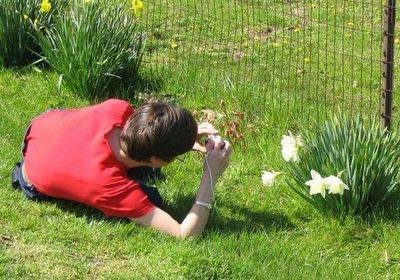
Gotta get the shot After seeing this photo of Bonnie, from Off the Top, getting that perfect shot, I decided to post this pic I took of two photogs, going that extra mile, to frame their shot just so. Of course, being in the right place, at the right time, sometimes helps - hence, my shot.
********
No ACLUnacy here You're walking through an open-air market and spy a rug for sale that has an image of Jesus on it. Close by you notice another rug with an image of the Virgin Mary. While public displays of anything religious may eventually be forbidden here in the United States (despite our First Amendment), it seems that such displays are permissible in the city of Abu Dhabi in the United Arab Emirates. (HT: a friend of mine living in Abu Dhabi)
********
Search engines: no thinking required Do an advanced search on Google with all of the words:
qualities required in a candidate for a dermatologist post
and you'll get this blog on the return.
********
Cambrian Explosion? What Cambrian Explosion? From a FoxNews interview of Stephen Meyer, of the Discovery Institute, and Eugenie Scott, of the National Center for Science Education, we get the following:
GIBSON: Ms. Scott, I, for instance, have read several pieces written by scientists who question the Cambrian explosion, in a relatively certain period of time, a sudden profusion of a gazillion different life forms, for which evolution doesn't seem to have enough time. What is wrong with raising that question with students? SCOTT: The so-called problem of the Cambrian explosion and it being a problem for evolution is nonsense. If you talk to paleontologists who actually study the Cambrian explosion and the Cambrian evolution of invertebrate body forms, they will tell you it's a fascinating puzzle, but it has no problem for evolution, even evolution through natural selection.
One wonders if it started snowing in the studio. Before Ms. Scott tries to pull a fast one like that she'd better do a bit more general research. She could start with On the Origin of Phyla, by James Valentine, an interview with Simon Conway Morris, from Reasons to Believe, and The Cambrian Explosion: Biology's Big Bang, by Meyer, Ross, Nelson, and Chien (or, even the wimpy explanation from PBS' Evolution series). HT: The ID Update

Tuesday, May 10, 2005

When the word “crap” means… crap

You would think that an associate pastor would, at the very least, have a basic understanding of the reverence that should attend the call to worship. You would think that an associate pastor would, at the very least, be cognizant of the fact that expressions of crude jocularity have no place within the call to worship. You would think that an associate pastor would, at the very least, have the common sense not to use even mildly vulgar language when attempting to make an un-Biblical illustration on how God can turn our dung into fertilizer. You would think. But then, you’d think that, a week later, an apology would also include an admission of wrongdoing. And you’d think that the “apology” would not attempt to sidestep the issue by accusing some congregants of taking the words spoken “out of context” (it was all really our fault, I guess). And you’d think that the “apology” would not be effectively negated by the senior pastor with a sarcastic admonition to the congregation in the form of, “I’m sure that none of you have ever made a mistake” (yeah, that’s the issue – the fact that none of us are perfect). You’d think.

Friday, May 06, 2005

Mothers and careers...

Update (see the end of this post)
********
I recently finished reading 7 Myths of Working Mothers: Why Children and (Most) Careers Just Don't Mix, by Suzanne Venker, and found it to be a very enjoyable read. As we prepare to celebrate Mother's Day, it seemed timely for me to share my thoughts on Venker's book. To say that Venker has chosen a hot topic is an understatement. Indeed, our society seemingly lives by the mantra that a woman's ultimate fulfillment comes not from her children, but from her career - having it all - if you will. Venker categorizes the seven myths as such,
"Men can have it all, why shouldn't we?" "I could never stay at home full-time." "You're so lucky you can stay home." "I could balance work and family if I had more support." "I'm a better mom for working." "My children love daycare." "I have it all planned out."
How much time does a career take? For those who truly wish to move up a corporate ladder or simply make a difference at their place of work - how much time must be devoted to the task? Venker reminds us that such occupations are full-time endeavors. So... what of the snippets of time left for - the children? She states,
The basic premise of 7 Myths of Working Mothers is that raising children is a full-time job, one that dramatically alters the paths women were on prior to becoming mothers.
She presents three basic arguments first claiming that while the choice to bring children into the world is an inherent right, choosing to do so without the intent to raise them is not. Secondly, she claims that if motherhood were viewed as a full-time job it would not be considered something that can be done on the side. Lastly, she argues that those who get paid to watch other people's children (e.g., daycare) are, in fact, doing the actual job of raising other people's children. Venker lays most of the blame for the myth that women can have a full-time career, while also being full-time mothers, squarely at the feet of the feminist movement.
...one of the reasons Betty Friedan, a founder of the National Organization for Women (NOW), won the support of so many women in the 1960s was that her organization appeared merely to support the idea that men and women should be treated equally. ...Every man and woman would be expected to earn an income, and children would not be raised in their own homes by their own parents, but would instead grow up in government-subsidized child care programs or in the care of come-and-go nannies. And, as it turns out, that's exactly what happened. But the women's movement went even further. Despite asserting that its platform was all about "choice," it simultaneously belabored the notion that full-time motherhood is not a worthy ambition, that children drag women down, and that women can only find true satisfaction in the workplace.
What are we to make of women who contend that they could never stay at home (with their children)? Venker leads off a chapter with a few lines of script from the television drama, Judging Amy,
"Mommy, I don't want you to work. Why can't you be more like Joey's mom? She stays at home with him." "Well, maybe that's because Joey's mother can't do anything else."
You got that, kid? You're not worth your mom staying home because she can do something else. The myth of "Oh, I could never stay home full-time." Venker relates the comment of one former working mother, who says, "It amazes me that women say this as though [being with one's children] were a punishment." Interestingly enough, on CNN.com, there's an article exhorting career mothers to "lose the guilt" this Mother's Day. In Master the Working-Mom Shuffle, Sarah Max evidently considers her four-day work week a sufficient enough sacrifice to warrant placing her two daughters in daycare for 25 hours per week. She writes,
Like many working moms, I sometimes fantasize about quitting my job to spend all day every day doing art projects and play dates with my soon-to-be three-year-old twin daughters, Fiona and Isabel. Instead, I work four days a week, count on my husband to take on key parenting duties and "let someone else raise my children" about 25 hours a week. (Someone else, where were you last night? The kids woke me up three different times.)
Max is clueless. Ask any full-time mother if she gets to spend all day every day doing art projects and play dates. Drop in on this full-time mother and you'll most likely find the house littered with piles of yet to do laundry which, after they're being processed, are replaced with new piles of yet to do laundry. If the mother is home schooling, then expect to find her explaining grammar to her 4th grader while guiding her pre-K child through a kindergarten level workbook, keeping in mind that she's also figuring out how to get the grocery shopping in after fixing lunch for her and her kids. More to the point, though, is the fact that the full-time mother, regardless of whether or not she is engaged in art projects all day every day with her kids, is the one who gets to impact their character formation. Despite the obvious nature of this point, it is lost on those who have bought in to the I could never stay at home full-time myth. Max writes,
Like a lot of working moms, there are days or weeks when I feel guilty and completely overwhelmed. Take recently, when I overheard Isabel tell Fiona, "When the little hand gets on the five, then you can have your mommy." I was heartbroken. I deconstructed that sentence a hundred times. "I pick them up at 4 o'clock, so why would Isabel say 5 o'clock?" ...I talked to my editor, came close to quitting my job, and then decided I wouldn't be happy expressing myself with construction paper. I also decided I'd wasted so many of my precious work hours obsessing about my issues I better turn the experience into something productive. So in honor of Mother's Day, I've been frantically researching the working mother's struggle to balance children, marriage, household, career and selfish indulgences, like showering and sleeping. (emphasis added)
The three year-old already understands (even if Mommy can't) where she sits in Mommy's list of needs. It's beneath Mommy to relate to her child at the construction paper level, so the child - her child - becomes simply one more category on her list of items in her life that she needs to balance in order for her life to be fulfilled:
Children Marriage Household Career Selfish indulgences (e.g., showering, sleeping)
Venker gives some very practical advice in her chapter on Myth #5, "I'm a Better Mom for Working." She relates that our society is fast-paced enough without having to add to it the stress of being a working-mother. Yet this added stress of trying to add a full or near full-time work schedule into the week can only wreak havoc on the well being of our children. And how can one consider themselves a better mom if, by their very choice of actions, they are depriving their children of a lifestyle conducive to healthy growth? Venker outlines the detrimental effects that a fast-paced schedule can have on a child's sleeping, eating, and exercise habits, as well as considering how effective one can be in disciplining a child when they only get to spend a few hours with them at the end of the day. Other aspects of the fast-paced lifestyle she touches on include how important consistency is with regards to school and homework, and how detrimental a lack of presence can be with regards to life after school. Perhaps the most disheartening chapter is the one which deals with Myth #6, "My Children Just Love Day Care." Max's CNN article reiterates this mantra with,
Research shows that children who go to "day school" are no better or worse off than those who stay home. "Whether a child is in childcare or not doesn't seem to make a difference," said Sarah Friedman, project scientist and scientific coordinator for the National Institute of Child Health and Human Development study of early child care and youth development, which began tracking infants in 1991. Although children who spend long hours in daycare may be slightly more prone to behavior problems -- just as adults who spend too much time at the office may be prone to behavior problems -- "the majority of children are in a normal range," said Friedman. "The worries that people had are not well-founded for the majority of the children." A better predictor of how the child will do is the family environment and -- interestingly enough -- household income. "More income seems to create conditions more favorable to development," said Friedman, explaining that this could be for any number of reasons, including that kids pick up on parents' stress over money matters.
It's truly amazing, isn't it? A supposedly well educated adult believing the statement, Whether a child is in childcare or not doesn't seem to make a difference. Do you really believe that placing a child - your child - into a group setting, to be cared for by adults who are performing the task for payment, compares with an environment in which the child - your child - is under your loving care? Are we to expect that a child - your child - will experience healthy emotional grow what with the multiple and temporary bonds that form with paid caregivers who periodically move on to other endeavors? Or are we to expect that a child - your child - will experience healthy emotional growth within the consistency of a stable environment at home? Never you mind, however, for the justification is complete with the line A better predictor of how the child will do is the family environment and -- interestingly enough -- household income. What better reason for positing the working mother myth? Venker closes the chapter with,
It is disturbing that we have become so used to day care that we do not appreciate that mothers are our most vital resource. Children do not raise themselves, and they do not "thrive" in day care. They just get used to it. CHildren will get used to anything we ask them to; this is why our power is so frightening. And it is the reason we have a responsibility not to ask our children to get used to anyone but us. Regardless of how a working mother explains to her children her reasons for being gone all day, the only thing her children will take from her explanation is that there's someplace else she would rather be.
Some mothers have to work. If they don't, there's no food for dinner. But many mothers have either bought into the myth of having it all, or they've been coerced into a lifestyle they'd just as soon get out of. If you're a working woman, considering having children, you would do yourself good by reading 7 Myths of Working Mothers. Update: I was wondering what types of comments, if any, would appear on this post. Let me say that it is refreshing to see so much of Venker’s analysis ringing true what with criticisms such as: the need for Dad to engage in more “motherly” activities (with the absurd claim that men are equally capable of performing the role of mother as women are), the need for flexible work hours, unequal comparisons cast as “equal” (e.g., comparing the results of a two-income family in which the working mother is deeply involved with her children’s education vs. a one-income family in which the stay-at-home mother does not care about her children’s education), predictions that a return to stay-at-home mothering will throw us back into the days of Leave it to Beaver, accusations that Venker has made generalizations and that she considers working mothers to not care about their children, as well as accusations that Venker has not done a thorough job of researching her work. Two overall points: Before generalizations and / or accusations are made as to what Venker has done, perhaps her accusers should read or, at least, seriously peruse her book? Also, I must reiterate that the issue is about whether or not a child is best raised by their mother. While there are complexities within the issue, the issue itself is not very complex. Consider the following scenario with the notion that the issue is about whether or not the parents care about their children. You have a two-income family and you have a one-income family. Both sets of parents care equally for their children’s welfare (in the sense that both sets have the same desires). I agree that husbands need to be more involved in parenting, so both of our husbands in this example contribute to the parenting equation. Now simply do the math. Subtract the time that the working mother must commit to her career and then compare the available time that the working mother has to be with her children vs. the available time that the stay-at-home mother has. Which set of kids will have the chance to get the proper amount of sleep? (kids need more sleep than adults – lots more) Which set of kids will have the chance to eat proper meals without being rushed? Which set of kids will find their mothers at home when they return from school? Which of the two mothers will understand that kids define “quality time” as “less time”? Which set of parents will have to find the time to make-up their time away from work (for “flexible time” just means that the work periods have shifted)? Which of the two mothers will have the time to… well, which of the two mothers will have the time?, period. I find the notion that men can perform the task of motherhood equally as well as women to be absurd. For one thing, there are physiological differences that should immediately inform us that men and women are not “equal” in this regard. While men can physically feed an infant with a breast-milk filled bottle, the bond formed pales in comparison to the one formed when a woman has breastfed her own baby. Regardless of how politically incorrect the following statement is, it remains true nonetheless, Women are physiologically better suited than men to raise children. If men are from Mars, and women are from Venus, it really shouldn’t be so difficult to see this point. But this criticism veers off from the main point of Venker’s book in that the issue isn’t really whether the role of mother is interchangeable between men and women, but whether or not a parent, preferably the mother, should be the one raising her own children. To argue that the man should take more a role in parenting (or mothering) does not justify the conclusion that the woman should take less of a role. The accusation that the likes of Venker want to throw us back into the day of Leave it to Beaver, while amusing, is unfounded. Did we ever really live like Leave it to Beaver? Underlying this criticism, however, is the notion of radical feminism. As Venker discusses, the feminist agenda is not “what’s best for the children,” but the so-called fact that women have been oppressed. She illustrates how radical feminism views offspring not as a blessing but, rather, as a hindrance to the ultimate self-fulfillment of women. That your average working-mother does not hold to such radical ideas is beside the point because the viewpoint she does hold owes its genesis to, and continues to be fed by, radical feminism. Simply put, Venker does not advocate that women volunteer to be subjugated, nor does she advocate relieving men of their fatherly responsibilities. She also does not recommend that women completely forego careers, nor does she claim that working-mothers do not care about their children. Lastly, regarding the issue of economic viability, Venker’s claim (to which I would agree) is that many two-income families are quite capable of existing off of one-income. The issue isn’t so much that they can’t as much as it is that they won’t. Again, do the math. Could you live off of one income? Is it impossible, or simply difficult? What do you want to have? What do you need to have? Are you entitled to send your child to Patrick Henry College regardless of whether or not you’re family income supports the costs? Do you, as a mother, spend 11 hours per day outside of your home, foregoing the raising of your own child, in order to be able to send him or her to PHC? Do the needs of society override your family’s needs? Are you expected to hand over your child’s upbringing to a paid stranger simply because we live in a consumerist society? For the good of the State? Children are resilient. They’ll accept quite a bit, especially if they have no choice.

Sunday, May 01, 2005

Pavlov Reloaded...

While viewing elephants at the San Diego Wild Animal Park, recently, we were told by one of the zookeepers to meander down to a gate which leads from their main paddock into a larger, much more open, area. The zookeepers had just dropped off piles of hay out in the larger paddock. It would soon be feeding time… and the elephants knew it. So we proceeded to the overlook point and positioned ourselves by the gate. A minute later it was opened and, sure enough, we got a great glimpse of all the elephants making a mad dash for the piles of hay – their afternoon dinner.
----------
The company I work for will, occasionally, have a lunchtime session on topics which vary from how to fill out an expense form to how to avoid stress. Typically you are expected to bring your own lunch to these sessions and, typically, they are not very well attended. Last week we had a lunchtime session on health and safety, with pizza and soda provided free of charge. There wasn't an empty seat in the conference room.
----------
Every Sunday we typically arrive at 8:45 a.m. for the 9 a.m. service at church. At that time the parking lot is sparsely filled, and remains so even at 9 a.m. As late as 9:20 a.m. stragglers are finding their way into either church or Sunday School. For those who may be thinking that it is difficult for people to get to church at the early hour of 9 a.m., it’s interesting to note that the phenomenon is essentially the same for the 10:45 a.m. service. A few Sunday nights ago our church had a special 5:30 p.m. dinner banquet promoting the various Missionaries they support. Arriving ten minutes early, at 5:20 p.m., I expected we would be one of the first families there. Much to my surprise we were actually one of the last to be seated! Oh yes, the dinner was free (save for the usual requests for donations). Food – the great motivator.